Message from the Regional Bee Inspector for Wales

Dear Beekeeper and association member,
We all know that this season has been a particularly busy one for swarms – it certainly has been in the area I live in south Wales and across the board from the reports I get.
Please can I ask those of you who are swarm collectors to make yourselves aware of the areas in the county and adjacent counties where you may be collecting swarms from where bee disease is present and to ensure that where you collect swarms in those areas they are hived solely onto new fresh foundation to reduce the risk of disease transmission through the storage of honey they bring with them, into drawn combs.
 If you are in a disease area and you put out ‘bait hives’ same thing again – please do not put out boxes with old combs or drawn combs in them as you are substantially increasing your risk of picking up foulbrood from incoming swarms.
Foundation should be used with some form of commercially available attractant and, if the bait hive is big enough the bees will occupy it, sometimes they will occupy a box with foundation without an attractant.
You can check the locations of outbreaks of foulbrood here which is freely available information on BeeBase :
 
Please remember when you view the above pages to look at both 2025 and previous years to see the area’s most at risk – the 2024 areas are just as important from a swarm point of view as 2025, we are early in the season and many of those areas identified in 2024 wont yet have received follow-up visits yet.
Where possible try to isolate incoming swarms you have hived in a separate isolation apiary and wait for two brood cycles, examining the brood closely and if you have any concerns please contact your local bee inspector who can be contacted by searching on your postcode on
your postcode on beebase: Contact Us » APHA – National Bee Unit – BeeBase if you are unsure as to what the National Bee Unit does this short film is quite useful from Beebase: About Us » APHA – National Bee Unit – BeeBase
Please try to log into your Beebase account and make sure that your apiary locations are up to date if they change – if they are up to date and we find any Statutory Notifiable Disease in your area you will be informed soonest. Having your email address on file means the notifications will come to you swiftly.
Bee Inspectors are all practicing – established Beekeepers and Beefarmers – we are here to help and there is no such thing as a daft question.
For those of you who are located within South Wales you may well have had a visit from me in the past and myself and the team of inspectors across Wales are currently booking up to see people in the radius surrounding where the latest outbreaks of European Foulbrood and American foulbrood has been discovered.
Our work is always done protecting the confidentiality of apiary site locations and beekeepers.
Many thanks again and happy beekeeping.
Kind regards.
Dan
Daniel Baxter
Regional Bee Inspector – Wales | Arolygydd Gwenyn Rhanbarthol – Cymru
National Bee Unit | Uned Gwenyn Cenedlaethol – Animal and Plant Health Agency (APHA) | Asiantaeth Iechyd Anifeiliaid a Phlanhigion
Mobile: 07771038646    Email: daniel.baxter@apha.gov.uk
National Bee Unit Website (BeeBase)/ Gwefan: www.nationalbeeunit.com
Follow us on / Dilynwch ni ar
Twitter/ Trydar: @NBU_APHA | Facebook/Gweplyfr: @APHANationalBeeUnit

Webinar – Swarming and Making Increase with Alan Baxter – Thu, May 8, 2025 7:30 PM – 9:00 PM

Swarming and Making Increase with Alan Baxter. Join us for a webinar on May 08, 2025 at 7:30 PM

Register now!

Alan’s talk begins by outlining the reasons why bees swarm, a little of the biology that explains why and how swarming occurs, then the swarming process itself including the communications that the bees use when choosing their new home.

In the second part of the talk Alan walks us through the ‘countdown’ to swarming, the signs to look out for, and the moment in the process when swarm prevention (or Pre-emptive control) becomes swarm control (or Re-active swarm control).

Finally, we will look at the practical steps a beekeeper can take to prevent a swarm occurring, then move on to methods of simple swarm control involving making increase, why we talk about artificial swarms, and simple methods of control for beekeepers who don’t want more colonies.

Alan Baxter is a Royal Marines Veteran who began his beekeeping adventure in the Loire Valley in France, where he attended University then worked in adult education and training for 23 years. His apiary there was the target of heavy predation by Asian Hornets and he developed apiary management techniques to help his bees survive the onslaught.

He moved to England in 2020 and manages 20 colonies of gentle bees in 3 apiaries in Hampshire. He has founded and runs a Teaching Apiary with courses, exam preparation and coaching sessions for his local beekeeping association. He has completed all the BBKA Modules and holds the General Beekeeping Husbandry Certificate. He continues studying to be a BBKA Master Beekeeper and is halfway through the Cornell University Master Beekeeper Program.

Alan writes regular blogs and articles and gives talks and seminars around the country on Beekeeping, the Asian Hornet, the Wines of the Loire Valley, and the 1982 Falklands War.

He is the author of the Hampshire Asian Hornet Contingency Plan and a book Fit2Fight- A Practical Guide to Managing the Asian Hornet published by Northern Bee Books Ltd.

https://www.alanbaxtersblogs.co.uk

After registering, you will receive a confirmation email containing information about joining the webinar.

View System Requirements

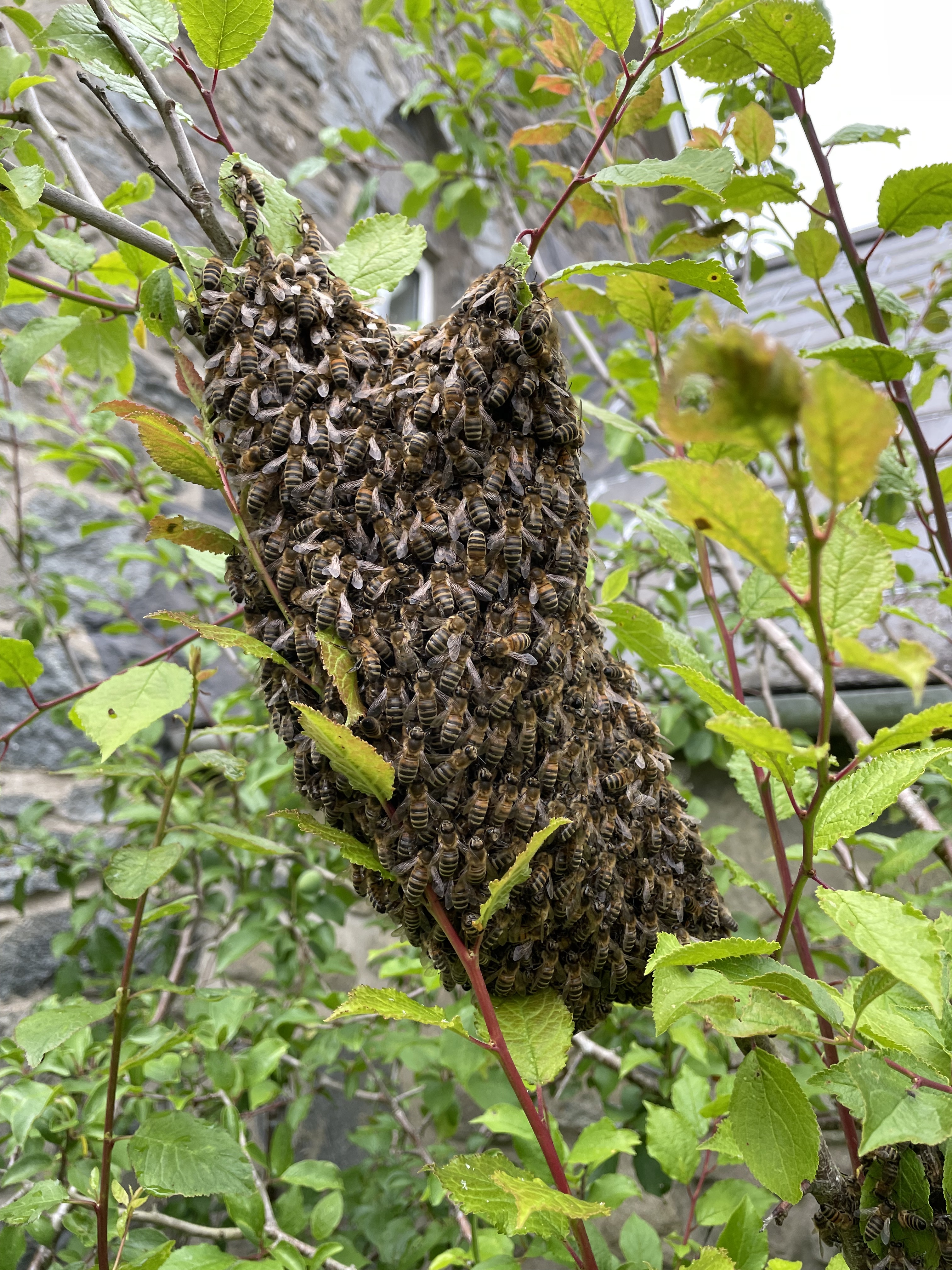
Advice if you think you have a Swarm of Honey Bees🐝

Pic by Linda Jones 2024

Honey Bees can swarm at any time from roughly mid-April to August. A swarm of bees can be a daunting sight, but swarming bees rarely sting: their objective is to find a new home as soon as possible.

PLEASE NOTE:

Ensure that what you have found are Honey Bees and NOT Bumble Bees or Wasps, etc. before contacting us, by using the following guide:

1. Wasps

Wasps do not swarm. Each year a new nest is built which looks like a paper lantern.  Close to it is easy to distinguish between wasps which are brighter yellow and with a narrower waist than the honey bee.  If insects are flying from a gap in roof tiles near the ridge, it can be tricky. If the nest is visible identification is easy. Please note that WE WILL NOT deal with Wasps or their nests – if a Pembrokeshire resident, call Pembrokeshire County Council’s Customer Contact Centre on 01437 764551 and ask for Pest Control.

See pics at Swarms – Heidiau

2. Bumblebees

Bumblebees do not swarm. Most people can recognise bumblebees they are much bigger and fewer than honey bees with layer of hairs on their bodies which is usually banded black and yellow (or orange or red) and the traffic at the nest entrance will consist of only a few bees a minute, whereas a busy hive will have almost a cloud of bees at the entrance. If you have bees in your bird box, they are probably the Tree Bumblebee (Bombus Hypnorum), which have come over from the continent in recent years.  They aren’t particularly aggressive, but are likely to defend their nest if they feel threatened. WE WILL BE UNABLE to help you with a Bumble Bee problem. The bees will disappear over the season and are unlikely to return to the same location, so if possible leave them alone and enjoy them for the summer.

See pics at Swarms – Heidiau

3. Solitary Bees

Solitary Bees do not swarm. Since these bees are quite fussy about where they set up their nests, it is not uncommon for many bees to do so in close proximity, and if the conditions are right a large number of nests can mature almost at the same time. In this case a large number of bees will be seen crawling about. One of the most common is the red mason bee, which can often be seen exploiting holes in brickwork or footpaths for its nesting site. WE WILL BE UNABLE to help you with Solitary Bees, so if possible, enjoy them for the summer.

See pics at Swarms – Heidiau

4. Honey bees

Honey Bees are about the same size as a wasp but are duller in colour – if you see a large cluster of thousands of insects hanging on a branch or fence post (see photo above) this may be a swarm of Honey Bees.

See above picture and Swarms – Heidiau

Please note:

  • We DO NOT recover bees from buildings, chimneys, etc for health and safety reasons and because of the potential structural damage that could be caused.  
  • We WILL NOT destroy Honey Bee nests this is a pest control problem. Honey Bees are not protected, so do not be put off if you are told this.  
  • If you are a Pembrokeshire resident, call Pembrokeshire County Council’s, Customer Contact Centre on 01437 764551 and ask for Pest Control. (Alternatively contact a professional Pest Removal company.)

Only if you have excluded all the above and need advice about Honey Bees, please contact:

PBKA Swarm Coordinator – Kenny Davies on 07968 360297